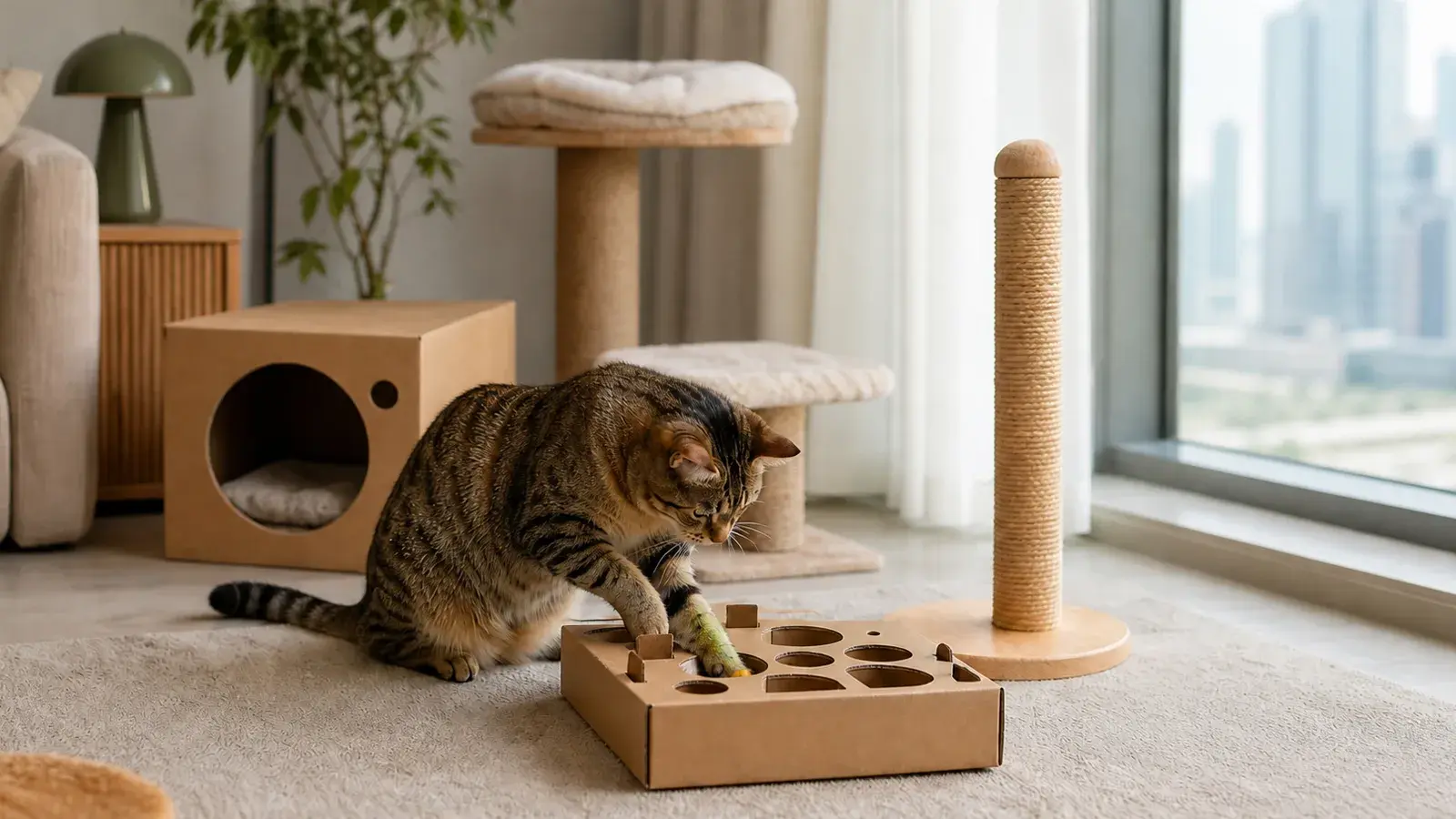
A useful indoor setup
- Give your cat a safe retreat and at least one elevated place to observe from.
- Offer stable scratching surfaces in the orientations and locations your cat prefers.
- Use short, interactive play that lets the cat stalk, chase and catch a toy.
- Introduce food puzzles gradually and count the food as part of the daily allowance.
- Separate key resources, especially in a multi-cat home, and let each cat choose when to interact.
- Secure windows and balconies; enrichment should never depend on unsafe access outside.
Indoor life removes some outdoor hazards, but four walls do not automatically meet a cat's behavioural needs. The Feline Veterinary Medical Association says indoor cats need an environment that supports their natural and normal behaviour. Its framework centres on safe space, separated resources, play and predatory behaviour, positive human interaction, and respect for a cat's sense of smell.
In the UAE, this is also a welfare question rather than a shopping list. Federal animal-welfare law requires a carer to account for an animal's type, development, adaptation and needs according to scientific knowledge and experience. The law sets the duty; the ideas below are practical editorial applications of recognised feline guidance, not additional legal rules.
Start with choices, not more clutter
Enrichment works when the cat can choose how to use the home. Begin by mapping five functions: retreat, height, scratching, play and feeding. A cardboard box in a quiet corner, a stable perch by a securely closed window and a scratcher near a sleeping area can be more useful than a crowded collection of toys.
Create a safe retreat and usable height
A retreat should be quiet, accessible and somewhere the cat will not be pulled out or disturbed. An open carrier with familiar bedding, a box with an entrance, or a covered bed can work. Add stable vertical choices such as a cat tree, shelf or window perch, adjusted for the cat's age and mobility. Never force a cat onto a perch.
Put scratching where it is useful
Scratching is normal behaviour. Offer a stable surface tall enough for a full stretch, plus a horizontal option if your cat scratches rugs or the floor. Useful locations include beside a regular sleeping place and near an existing furniture target. Reward investigation calmly; do not shout, spray water or punish the cat for choosing the wrong surface.
Make play resemble a small hunt
Move a wand toy away from the cat, around furniture edges and through pauses so it behaves more like prey than a feather waved at the face. Let the cat stalk and catch it. Short sessions can suit many cats better than one long session; the right length depends on age, health, interest and fitness.
- Put wand toys away after play so cords cannot be swallowed or tangled around the cat.
- Avoid using hands and feet as prey.
- Rotate a small selection of safe toys instead of leaving everything out.
- Stop if the cat walks away, hides, flattens its ears or becomes agitated.
- Give each cat separate play opportunities if one repeatedly takes over.
Turn part of a meal into an activity
Puzzle feeders and small food searches can add foraging and problem-solving. Start easy: place a little of the cat's normal food in an open egg-box-style tray or simple rolling feeder while keeping familiar feeding available. Increase difficulty only when the cat uses it confidently.
Spread resources through a multi-cat home
Cats living together do not necessarily want to share everything. Feline environmental guidelines recommend multiple, separated locations for hiding, resting, toileting, food, water, play and scratching so one cat cannot quietly control access. Avoid lining all bowls and litter trays together; that creates one resource station rather than genuine choice.
Build a realistic UAE daily routine
During long hot or humid periods, an indoor routine is especially practical because it does not depend on balcony time or outdoor access. This is an editorial adaptation, not a veterinary schedule: attach brief play to events you already repeat, such as before breakfast and after returning home, refresh a food puzzle or hiding place, and keep comfortable resting choices available in the cooled living area.
- Morning: one short interactive play session followed by the normal meal.
- Daytime: access to retreat, height, water, litter and a safe independent activity.
- Evening: another play opportunity and a simple food search using the daily allowance.
- Weekly: rotate toys, inspect scratchers and barriers, and note which choices the cat actually uses.
Know when enrichment is not the whole answer
A sudden change in play, appetite, toileting, grooming, sleep, movement or sociability can have a health or welfare cause. Do not label it boredom or attempt to diagnose it at home. Contact a licensed veterinarian promptly, particularly if the cat is not eating, is straining to urinate, has breathing difficulty, is injured or seems acutely unwell.
A simple seven-day reset
- Add or improve one undisturbed hiding place.
- Test one stable vertical perch and one secure window view.
- Place a preferred scratching surface beside a rest or scratch location.
- Schedule two brief opportunities for interactive play and follow the cat's response.
- Offer an easy puzzle using part of the normal meal.
- Separate resources that are clustered together or easily guarded.
- Review what the cat chose, keep what worked and change only one weak point at a time.
If you are preparing to bring a cat home, start with the Dubai pet-adoption readiness checklist. A modest home can support a rich indoor life when the setup gives the cat safe choices and the routine responds to the individual in front of you.